The essentials
- Equity crowdfunding is done through a platform authorised by the CNMV as a crowdfunding service provider.
- The European regulation limits its scope to offers of up to five million euros per project owner over twelve months across the European Union.
- A non-sophisticated investor goes through a knowledge test, a loss-bearing simulation and a four calendar day reflection period.
- Issuing under Law 6/2023 is a different route: a different framework, different limits, and the relationship with the investor stays with your brand.
What it is exactly
Equity crowdfunding means raising capital from many individual investors in exchange for a stake in the company's share capital, through a platform that brings project owners and investors together and that is authorised and supervised to do so.
The key word is platform. It is not a shop window website: in Spain it is a crowdfunding service provider authorised by the CNMV under Regulation (EU) 2020/1503 of 7 October 2020, and that authorisation brings specific obligations on information, on due diligence over the project and on investor protection.
The limits the regulation imposes
The European regulation, applicable since 10 November 2021, replaced the scattered national regimes with a common one. Its size rules are the ones that most shape the decision.
- Five million euros per project owner over twelve months, counting all offers by that project owner in the European Union. It is the regulation itself that draws its scope there: above that figure the offer falls outside the crowdfunding regime. Spain adapted its national regime with Law 18/2022 of 28 September on the creation and growth of companies.
- European passport. A platform authorised in one member state can operate in the rest without applying for a licence again, which opens the offer to investors in other countries without setting up a structure per country.
- Key investment information sheet. The project owner draws it up and the platform reviews it. It is the document the investor has in front of them when deciding.
What protects the retail investor
Here lies the most visible difference from a round among professionals. The regulation distinguishes between sophisticated and non-sophisticated investors, and over the latter it builds a layer of protection that the project owner has to take into account, because it affects conversion.
- Entry test on investment knowledge and experience.
- Simulation of the ability to bear losses, based on their financial situation.
- Specific risk warning when the investment exceeds the higher of two amounts: one thousand euros or 5 % of their net worth.
- Pre-contractual reflection period of four calendar days, during which they can revoke their offer without giving reasons and without penalty. The platform also cannot transfer the money to the project owner before that period ends.
What it costs and what you take away
The usual platform model combines a success fee on the amount raised with payment gateway costs and, in some cases, an upfront fee to prepare the campaign. The market range moves around the mid single digits on the amount raised, and it is worth asking for it broken down before signing.
The other cost does not appear on the invoice: the relationship with the investor belongs to the platform. The data on who has invested, the later communications, the space where the investor checks their position and the purchase experience itself all live outside your brand. For a company raising from strangers that makes no difference. For a brand raising from its own customers it is exactly what it wanted to avoid.
How it differs from issuing yourself
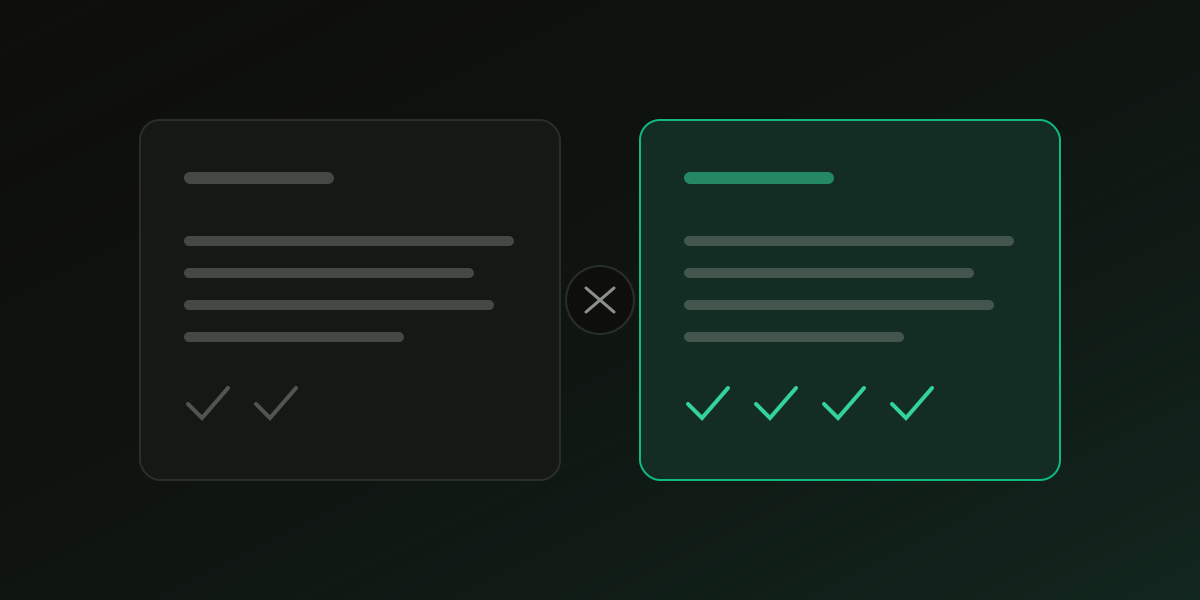
Issuing shares under Law 6/2023 is a different route, not an informal version of the previous one. It has its own framework, its own participants and its own limits.
| Equity crowdfunding | Your own issuance | |
|---|---|---|
| Framework | Regulation (EU) 2020/1503 | Law 6/2023 and Royal Decree 814/2023 |
| Who authorises | CNMV, with a European passport | Nobody: there is no prior authorisation (Art. 34) |
| Amount cap | €5 million per project owner over 12 months in the EU | Below €8 million in the EU, over 12 months, with no prospectus |
| Who intermediates | Platform authorised by the CNMV | Authorised entity that validates and supervises |
| Where the investor subscribes | On the platform | In a space carrying your brand |
| Whose the relationship is | The platform's | The brand's |
| Register of ownership | According to the platform's model | Digital register with a responsible entity and registration of each holding |
Neither is better in the abstract. If what you are after is access to investors who don't know you, the platform gives you distribution. If what you already have is a customer base that buys from you every month, what you need is not distribution: it is a structure that doesn't break your cap table and an experience that doesn't take your customer out of your brand.
Frequently asked questions
Is equity crowdfunding regulated in Spain?
Yes. It is governed by Regulation (EU) 2020/1503 of 7 October 2020, applicable since 10 November 2021, and platforms must be authorised by the CNMV as crowdfunding service providers. Law 18/2022 on the creation and growth of companies adapted the Spanish regime to that framework.
How much can an individual invest?
The regulation does not set an absolute cap for the non-sophisticated investor, but it does require a risk warning and an express confirmation when the investment exceeds the higher of two amounts: one thousand euros or 5 per cent of their net worth. There is also an entry test, a simulation of the ability to bear losses and a pre-contractual reflection period of four calendar days during which they can revoke their offer.
Can I run a crowdfunding campaign and also issue on my own?
They are routes with different frameworks and they do not simply add up: the amount limits are calculated under different rules, and coordinating the two affects how the same project owner's offers are counted over twelve months. It is a question for legal counsel before planning the calendar, not after.
What happens to my investors when the campaign ends?
It depends on the platform's model. In some cases ownership is registered through the platform itself and later communications go through it; in others the investors enter the share capital directly. It is the question worth asking before signing, because it determines whether in two years' time you have a relationship with those investors or somebody else does.
Legislation and sources cited
- Regulation (EU) 2020/1503 of the European Parliament and of the Council of 7 October 2020 on European crowdfunding service providers for business (DOUE-L-2020-81532). Scope, protection of the non-sophisticated investor and pre-contractual reflection period.
- Law 18/2022 of 28 September on the creation and growth of companies (BOE-A-2022-15818). Adaptation of the Spanish regime to the European regulation.
- Law 6/2023 of 17 March on Securities Markets and Investment Services (BOE-A-2023-7053). Arts. 34, 35.2.b and 36.1, for the comparison with issuing yourself.
Updated 16 Sep 2026. This article is for general information and does not constitute legal or financial advice. The specific terms of each transaction depend on its structure and should be reviewed with professional advice.