- 8 to 12weeks
- From structuring to a live issuance.
- 1line
- Every shareholder, aggregated on your cap table through an SPV.
- 100%
- Of the relationship with your shareholders happens under your brand.
- 0euros
- To assess how well your brand fits with us.
The mismatch
Your customers create value. But they never capture it.
They buy your products. They recommend you to their friends. They defend your brand on social media. They make you grow. And when you raise capital, they are left out entirely.
Meanwhile, your funding processes are complex and cost you control.
What if your best customers could also be your shareholders?
Today
Your customers drive your growth with no way to share in it
Your funding rounds are complex and dilute your control
Retaining customers is harder in an ever more competitive market
You spend too much on marketing to keep your brand growing
With Ownex
Your customers become shareholders and share in the growth
Capital comes from your community, with a clean cap table and control preserved
Loyal customers who choose your brand over the competition
A community with a sense of belonging that grows your brand with you
The Ownex thesis
Your biggest asset is already built. Shall we activate it?
Customer loyalty is now a priority for every consumer brand. Turning customers into shareholders is the main way to earn it, making them part of the business and strengthening both their retention and their commitment to the company's growth.
Peer-reviewed studies that back the thesis
Holding shares motivates people to behave as loyal customers and to stand up for the brand.
Aspara, J. (2009)
Stock ownership as a motivation of brand-loyal and brand-supportive behaviorsOpening equity to the community does more than raise money: it is a way to acquire loyal customers.
Hoffmann, C., Moritz, A. and Kenning, P. (2022)
More than a financial alternative: discovering equity crowdfunding as a tool for entrepreneurial ventures to acquire loyal customersUnderstanding and using a brand's product pushes people to invest in it: customer and investor tend to be the same person.
Righi, R., Pedrazzoli, A., Righi, S. and Venturelli, V. (2024)
The clientele effects in equity crowdfunding: A complex network analysisThe BrewDog case: the round opened to its customers built a brand community, not just a shareholder base.
Sabia, L., Bell, R. and Bozward, D. (2022)
Using equity crowdfunding to build a loyal brand community: The case of BrewDog
Study 1 of 4: Aspara, J. (2009)
What Ownex is
Everything you need for your customers to invest in your brand.
An end-to-end B2B platform for co-ownership: legal structuring, issuance of fractional shares and ongoing shareholder management. You focus on the brand. We take care of the rest.
Structuring
We build the legal and financial structure so your round meets regulatory standards and your cap table stays clean, without complicating future rounds.
Issuance
We run the round aimed at your community, covering the issuance process end to end and coordinating with regulated financial entities.
Activation
We run the relationship after closing: shareholder management, benefit activation, dividend management and periodic reporting.
How it works
A single platform for managing the whole issuance and its shareholders.
The dashboard that controls the issuance, the investor management panel and the portal under your brand that your customers and investors log in to. All three come integrated in the same platform.
Access: Ownex and issuer
Full visibility of where your issuance stands.
The complete issuance file, with the status of every document and the entity responsible for it: what the lawyer has certified, what the notary has executed as a public deed, what the investment firm has validated and what is recorded in the register.
- The authorised investment firm validates the investor information before the offering opens
- The registry entity records the shares at closing and issues the legitimation certificates
- Every regulatory obligation is assigned to an authorised entity
Access: issuer
Your investor base, managed from a single place.
Who has invested, how much and in which tier, alongside the engine that launches benefits and communications. The shareholder register stays up to date with no manual work.
- Shareholder register up to date, with no spreadsheets running alongside
- Segmentation by tier and by activity
- Benefits and communications aimed at a specific segment
Access: investors
Subscription and tracking without leaving the brand's domain.

Under your own brand. It is where people subscribe while the offering is open and where, afterwards, each shareholder checks their position, activates benefits and votes.
- Subscription with KYC built in, without leaving the issuer's domain
- Position and tier updated at all times
- Voting at the shareholders' meeting and benefit activation
Issuance simulator
How much capital can your community contribute?
Choose how you want to raise the money, enter your assumptions and get an estimate of the capital you can raise and of what it costs to structure the deal.
Your community comes in as shareholders: you don't repay the capital, you give up a share of the ownership.
- Raisable capital
- €150,000
- Dilution
- 7.0%
- Estimated cost
- €18,000 to €29,000
Customers in your base you expect would subscribe.
If it isn't closed yet, enter the reference valuation you're working with.
Cost vs. capitalEstimated cost by capital raised
Indicative estimate based on the assumptions entered. It is not a fundraising commitment or an offer of securities.
Regulatory framework
Every issuance complies with Spanish securities regulation.
We structure every issuance under the LMVSI, the Spanish law that transposes MiFID II and governs the issuance of securities. We don't operate in legal vacuums or grey areas.
We coordinate every issuance with authorised entities (ESI/ERIR) and prepare the full legal documentation: prospectus or exemption, SPV structure, shareholders' agreement and KYC/AML flow.
LMVSI
Spanish Securities Markets and Investment Services Act
Spanish legislation that transposes MiFID II and governs the issuance of securities.
Law 6/2023, of 17 March
ESI and ERIR
Regulated entities
The ESI (an authorised investment firm) validates the investor information and supervises the marketing; the ERIR (the entity in charge of the register) keeps the register of the securities. Your brand needs no licence of its own.
Supervised by the CNMV
DLT Pilot Regime
Secondary market
European pilot regime that enables market infrastructures based on distributed ledger technology, including a secondary market for digital securities.
Regulation (EU) 2022/858
In practice
Same infrastructure, a solution adapted to each sector.
If your customers are already loyal, give them a financial reason to stay.
Your customers wear your brand. Let them own it too.
A fashion brand with a loyal community opens a round to its best customers. Shareholders get access to exclusive drops, vote on design decisions and share in the rise in value of the business.
- Access to collections before anyone else
- A vote on product decisions
- A share in the brand's rise in value
Your regulars fund your expansion.
A restaurant group lets its most loyal customers invest in opening new locations. The result: shareholders who bring bookings, not just likes.
- Capital for new locations without depending on banks alone
- Shareholders who refer because they share in the rise in value
- Access to exclusive experiences in the venue
Your community trains with you. And grows with you.
A gym chain, a box or a yoga studio offers its members the chance to become shareholders. They take part in decisions on new services, get preferential terms and share in the results of the business.
- Retention through ownership, not through discounts
- New services co-designed with the people who use them
- If the centre grows, the member who is also a shareholder benefits
Your sector isn't on the list? The logic is the same.
Ownex doesn't depend on the sector, it depends on the relationship. If you have a customer base that comes back, that recommends you and that identifies with what you do, that base can fund you. The structure is the same for retail, leisure, hotels, education or subscription services.
- Works for any brand with recurring customers
- The legal structure doesn't change from one sector to another
- On a call we'll tell you whether your case fits
Who qualifies
Is the Ownex system right for my brand?
You have a consumer brand with customers who come back, and you plan to raise capital or expand.
- Consumer brand with recurring revenue
- Operator planning new locations or product lines
- Founder who wants capital from their community, not only from VCs
- Any sector with customers who come back: there is no closed list
Designed for brands with large communities and loyal, recurring customer bases.
See if my brand fitsResources
Want to learn how tokenisation is disrupting startup financing?
Guides on what really decides a round aimed at your own customers: the corporate structure, what Spanish law requires and how it is all run once there are hundreds of investors.
 Structure and regulation9 min
How to open a funding round to your customers in Spain
What structure you need, what Law 6/2023 requires and why the €90,000 limit everyone quotes is not a legal limit.
Read the article Community and investors9 min
How much capital your community can contribute, and how to estimate it
Three variables, three scenarios and a check against rounds already closed, to see what amount your customer base supports.
Read the article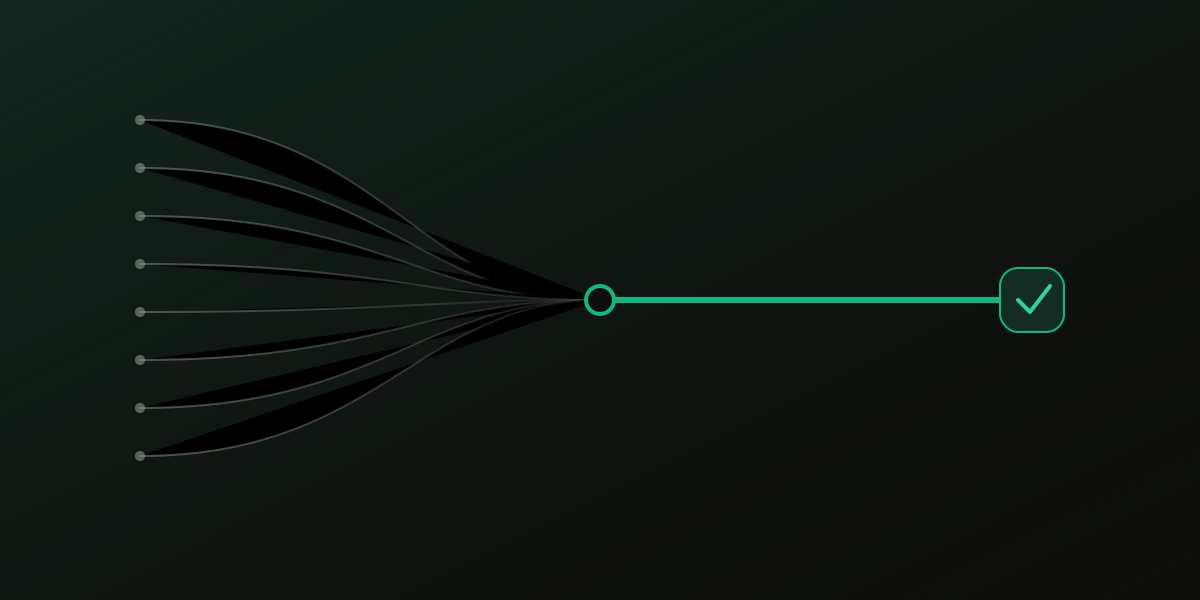 Structure and regulation7 min
What an SPV is and why your next round depends on it
How a vehicle groups hundreds of investors into a single line, what the investor keeps and the three mistakes that keep repeating.
Read the article
Frequently asked questions
Still have questions?
These are the answers to the questions we hear most.
No. Traditional crowdfunding runs through generic platforms where a project competes for attention with thousands of others: the offering is mass-market, the experience is disconnected from the brand and the relationship with the investor ends when the campaign does. Ownex structures equity rounds aimed exclusively at the brand's own community. The issuance is made through an SPV, coordinated with regulated entities, and there is no intermediary platform: the capital comes from people who already know and use the product.
And that is where most issuance platforms fall short: they issue and disappear. Ownex operates the Owner Hub, integrated into the brand's own website, where shareholders manage their stake, receive updates, activate exclusive benefits and take part in decisions. The issuance is the start of the relationship, not the end of it.
Shares in an SPV (a special purpose vehicle) that holds a minority stake in the operating company. It is real equity, with economic rights and, depending on the structure, limited voting rights. This website uses “shareholder” as a plain-language term; legally the position is that of a member or partner of the vehicle, depending on its corporate form.
Dilution depends on the size of the round and on the valuation agreed in each case, and the specific figure is calculated on your brand's own numbers. What doesn't change is the shape: the SPV aggregates every shareholder into a single line of the cap table, so the structure doesn't get more complicated as investors are added and the capitalisation table stays clean and compatible with future VC rounds or an exit process.
For consumer brands with recurring customers and an active community. It works particularly well in fashion, streetwear, restaurants, gyms, sport, lifestyle and retail. Sectors where the customer brand relationship is already strong and expansion capital can come from the customer base itself.
Typical issuances range from €100,000 to €1,000,000, depending on the size of the community, the average ticket per investor and the company's valuation. For brands with larger communities, bigger issuances are possible within the same regulatory framework.
The brand needs no licence of its own. Ownex coordinates each issuance with authorised investment firms (ESI) or registered entities (ERIR), and regulatory supervision rests with them.
The split is this: Ownex designs the equity structure, builds the Owner Hub and runs shareholder activation; the regulated partners (ESI/ERIR) supervise the issuance and regulatory compliance; the registration and issuance infrastructure is provided by a white-label provider integrated into the system. Ownex is the architect and operator, the regulated partners are the supervisors, and the technology is the invisible infrastructure.
No. The shares represent real equity in a regulated SPV, and today there is no open secondary market and no listing: nobody buys and sells positions from one day to the next. The digital infrastructure is used for the register (digital cap table, traceability, automated regulatory compliance), not for speculation. The European pilot regime (Regulation (EU) 2022/858) does enable secondary market infrastructures for digital securities, and that is where shareholder liquidity is heading in the medium term, always within that supervised framework.
The full process, from legal structuring to a live issuance, takes 8 to 12 weeks. The cost has two parts: fixed costs paid to third parties (lawyers, incorporating the vehicle and notary fees, regulatory validation and onboarding onto the digital register), which are incurred before anything is raised, and an Ownex success fee charged only when the round closes. The simulator on this page gives you an estimate with your own numbers, and we send you the full breakdown by email or go through it on the call.